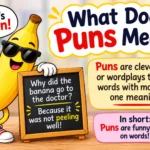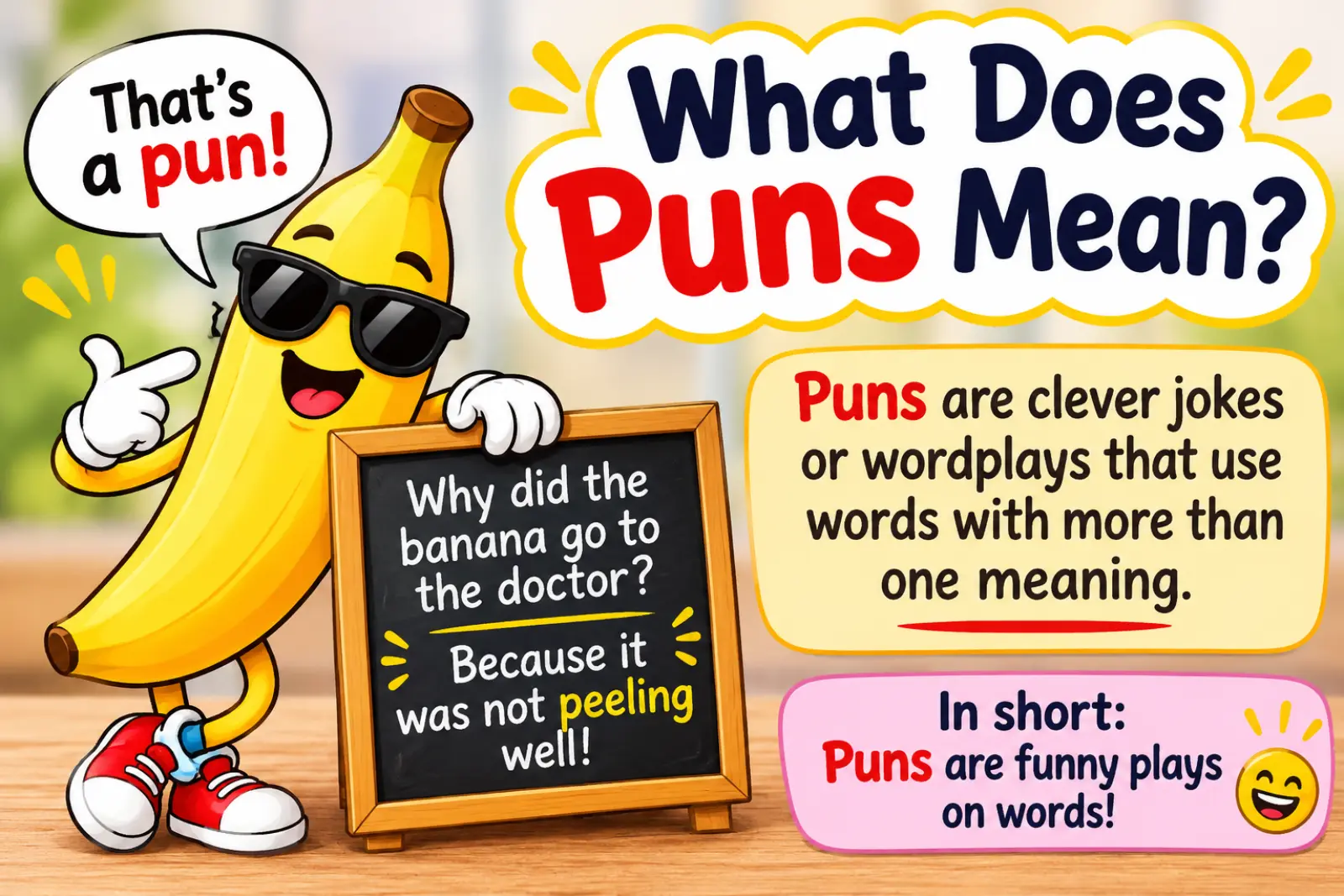
What does puns mean? A pun is a clever form of wordplay that uses words with multiple meanings or similar sounds to create humor, surprise, or a witty expression. Puns make ordinary sentences more entertaining by giving familiar words an unexpected twist. Whether it’s a funny joke, a clever caption, or a playful conversation, understanding the meaning of puns can make everyday language a lot more fun.
In this guide, you’ll discover what puns mean, how they work, different types of puns, and 150 funny examples that make wordplay easy to understand. From simple English puns to clever one-liners and family-friendly jokes, there’s something for everyone. Use these examples in Instagram captions, social media posts, text messages, greeting cards, or everyday conversations. Our copy-friendly collection makes finding and sharing your favorite wordplay easy!
What Does Puns Mean? Simple and Clear Explanations
- Puns are jokes that play with words that have more than one meaning or sound alike.
- A pun is a type of wordplay that makes language funny through clever connections.
- Puns use familiar words in unexpected ways to create humorous meanings.
- A pun can make one sentence communicate two different ideas at the same time.
- Puns often depend on homophones, which are words that sound alike but have different meanings.
- Some puns use homonyms, words that share the same spelling or pronunciation but have different meanings.
- A pun can turn an ordinary statement into a clever joke.
- Writers use puns to make stories, poems, advertisements, and conversations more entertaining.
- Puns are sometimes called plays on words because they give language a humorous twist.
- A good pun makes readers think about a word in more than one way.
- Puns can be simple enough for children to understand or clever enough to make adults think twice.
- Some puns are funny because they create an unexpected connection between unrelated subjects.
- A pun can be spoken, written, printed on a greeting card, or shared online.
- The main purpose of a humorous pun is to entertain through clever language.
- In simple words, a pun is a joke that makes words work overtime!
Funny Examples of Puns and Their Meanings
- I used to be a baker, but I couldn’t make enough dough. – Dough means bread mixture and money.
- The bicycle couldn’t stand up because it was two-tired. – A play on “too tired” and two tires.
- I’m reading a book about anti-gravity. It’s impossible to put down. – Put down means stop reading or physically lower something.
- The calendar’s days are numbered. – Its days are literally counted.
- The math teacher has too many problems. – Problems means math questions and personal difficulties.
- I wondered why the baseball was getting bigger. Then it hit me. – Hit means understand suddenly and strike physically.
- The fisherman was hooked on his hobby. – Hooked means caught by a hook and deeply interested.
- The computer caught a virus, so it needed a byte of medicine. – Byte is a computing term that sounds like bite.
- The musician got into treble for playing too loudly. – Treble sounds like trouble and refers to a musical range.
- The restaurant chef had a lot on his plate. – It means both a busy workload and food.
- The gardener was outstanding in his field. – He was literally standing in a field and was excellent at his work.
- The electrician was shocked by the news. – Shocked means surprised and relates to electricity.
- The shoe factory had a lot of sole-searching to do. – Sole sounds like soul.
- The clock factory workers had a second job. – Second refers to time and another job.
- The comedian’s jokes were so cheesy that they were grate. – Grate sounds like great and relates to cheese.
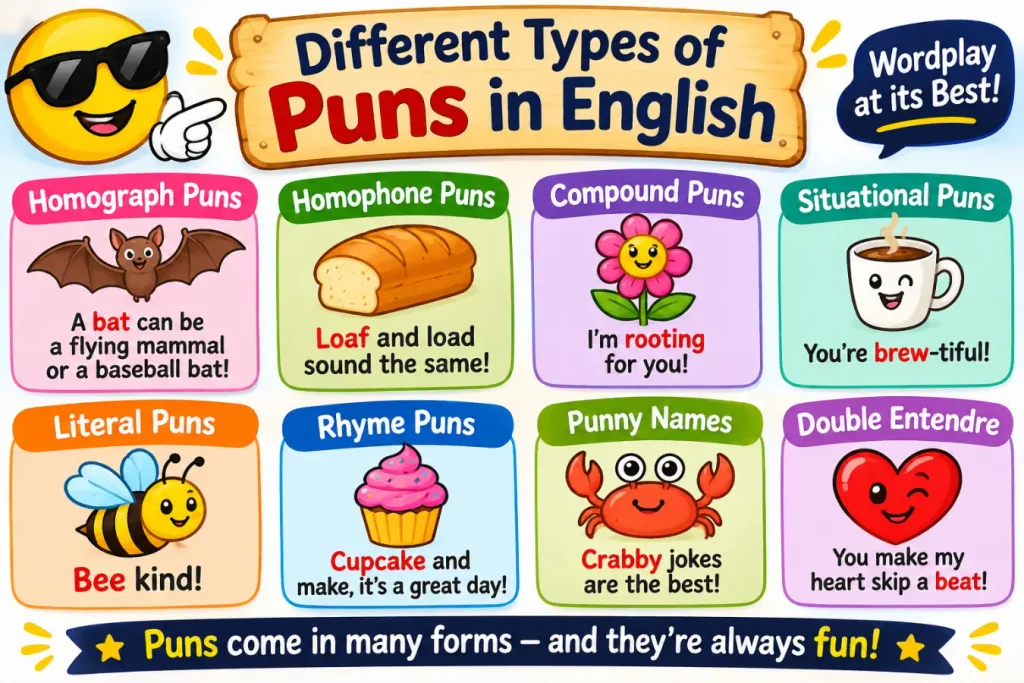
Different Types of Puns in English
- Homophonic puns: These use words that sound alike, such as “flower” and “flour.”
- Homographic puns: These use words spelled the same but with different meanings, such as “bark” from a tree and a dog’s bark.
- Homonymic puns: These use words that share spelling or pronunciation but have different meanings.
- Compound puns: These combine multiple wordplays in one joke.
- Visual puns: These use pictures or illustrations to communicate two meanings.
- Double-entendre puns: These use expressions with two possible interpretations.
- One-liner puns: These deliver a complete joke in one short sentence.
- Question-and-answer puns: These use a question followed by a surprising wordplay answer.
- Situational puns: These use a particular event or situation to create humor.
- Literary puns: These appear in poems, novels, plays, and other written works.
- Name puns: These turn people’s names into funny expressions or jokes.
- Food puns: These use food-related words to create amusing double meanings.
- Animal puns: These play with animal names, sounds, and characteristics.
- Visual-verbal puns: These combine written words with images to create a double meaning.
- Bilingual puns: These use similarities between words in two languages to create humor.
Short and Simple Puns for Beginners
- I donut know what I’d do without you.
- You’re tea-riffic!
- Let’s taco ’bout happiness.
- I’m kind of a big dill.
- You make miso happy.
- Have an egg-cellent day!
- I’m feeling grape today.
- You’re one in a melon.
- Don’t go bacon my heart.
- Life is butter with friends.
- I’m soy into this!
- Orange you glad we’re friends?
- You’re paws-itively amazing.
- Whale, hello there!
- I carrot believe how funny this is.
Clever Puns That Show How Wordplay Works
- A boiled egg is hard to beat. – Beat means defeat and physically whisk an egg.
- The banker’s favorite exercise is running a balance. – A balance can refer to money or physical stability.
- The photographer had a developing problem. – Developing refers to photographs and personal progress.
- The gardener planted a few ideas. – Planting can mean putting seeds in soil or introducing thoughts.
- The tailor made a good point. – Point refers to an argument and a sewing needle.
- The lawyer had a brief career. – Brief means short and also refers to a legal document.
- The orchestra had a lot of potential. – Potential can describe ability and electrical energy.
- The dentist’s business was looking up. – Looking up suggests improvement and looking inside someone’s mouth.
- The pilot had a soaring career. – Soaring refers to flying high and achieving success.
- The gardener’s business really grew on people. – Growing refers to plants and increasing popularity.
- The librarian checked out because she had too many books. – Checked out refers to borrowing books and leaving.
- The carpenter nailed the presentation. – Nailed means performed successfully and used nails.
- The astronomer had a stellar reputation. – Stellar means excellent and related to stars.
- The musician found the perfect note to end on. – Note means a musical sound and a written message.
- The chef was on a roll with his latest recipe. – A roll is food and a phrase for making progress.
Cute and Family-Friendly Puns for Everyone
- You’re pawsome, and that’s the whole truth!
- I love you berry much.
- You make my heart skip a beet.
- You’re my butter half.
- I’m stuck on you like glue.
- You are tea-lightful!
- Have a purr-fectly wonderful day.
- You’re simply un-bee-lievable.
- I love you a latte.
- You make every day sunny-side up.
- You’re the apple of my pie.
- We make a great pear.
- You are one smart cookie.
- I’m so fondue of you.
- You’re my favorite human bean.
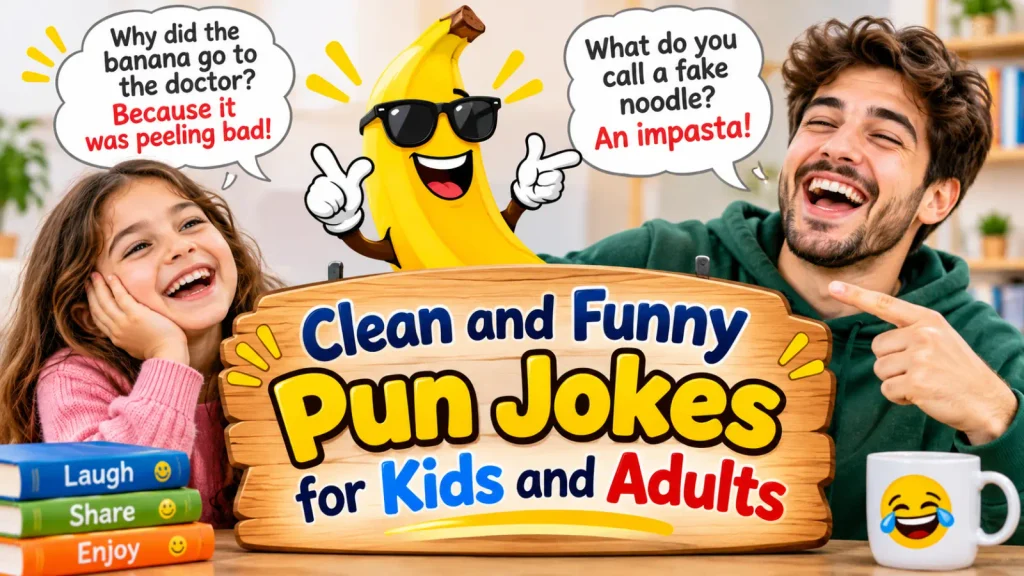
Clean and Funny Pun Jokes for Kids and Adults
- Why did the banana go to the doctor? Because it wasn’t peeling well.
- Why did the bicycle fall over? It was two-tired.
- Why was the math book sad? It had too many problems.
- Why did the scarecrow win an award? He was outstanding in his field.
- Why did the tomato blush? It saw the salad dressing.
- Why was the computer cold? It left its Windows open.
- Why did the golfer bring two pairs of pants? In case he got a hole in one.
- Why did the cookie go to the hospital? It felt crummy.
- Why did the music teacher need a ladder? To reach the high notes.
- Why did the cow become an astronaut? It wanted to visit the Milky Way.
- Why did the book join the gym? It wanted a stronger spine.
- Why did the orange stop rolling? It ran out of juice.
- Why did the clock get promoted? It was always ahead of its time.
- Why did the baker become a comedian? He had a knack for rolling with the dough.
- Why did the pencil get an award? It made a good point.
Funny Puns for Instagram Captions and Social Media
- Just trying to make a little pun-sense of life.
- Wordplay is my favorite kind of play.
- I’m having a pun-derful day!
- Too punny to be taken seriously.
- Life is short, so make every word count.
- Keeping things pun and games.
- My humor has multiple meanings.
- Sorry for the pun-expected laughter.
- Just here to make words more interesting.
- A little wordplay goes a long way.
- Making my captions pun-stoppable.
- Living life one clever phrase at a time.
- Warning: My jokes may cause eye rolls.
- I like my humor with a double meaning.
- If words were a sport, I’d be playing for pun points.
Famous and Literary Examples of Puns in English
- William Shakespeare’s wordplay: Shakespeare frequently used double meanings and clever expressions in his plays.
- Romeo and Juliet: Mercutio uses wordplay about being wounded and dying in a conversation with Romeo.
- Hamlet: Shakespeare uses humorous wordplay involving graves, death, and the idea of being buried.
- Much Ado About Nothing: The title itself plays with the historical double meaning of “nothing,” which could also refer to female anatomy.
- Alice’s Adventures in Wonderland: Lewis Carroll uses playful language, unusual expressions, and multiple meanings throughout the story.
- Through the Looking-Glass: Carroll’s writing includes imaginative wordplay and language puzzles.
- A Midsummer Night’s Dream: Shakespeare uses humorous language and wordplay to create entertaining dialogue.
- The Importance of Being Earnest: Oscar Wilde plays with the similarity between the name Ernest and the word earnest.
- The Merchant of Venice: Shakespeare uses witty exchanges and expressions with multiple meanings.
- Much Ado About Nothing: The characters use witty banter and playful language throughout the comedy.
- The Jabberwocky poem: Lewis Carroll creates imaginative words that encourage readers to explore language creatively.
- Dr. Seuss books: Many stories use rhymes, sound patterns, and playful language that appeal to young readers.
- The Canterbury Tales: Geoffrey Chaucer uses wordplay and humorous language in several stories.
- The Adventures of Tom Sawyer: Mark Twain uses humorous expressions and clever dialogue.
- The works of Oscar Wilde: Wilde is well known for witty remarks, irony, and clever double meanings.
How to Make Your Own Funny Puns: 15 Easy Tips
- Find words with multiple meanings: Start with a word such as “light” and explore its different uses.
- Look for similar-sounding words: Try pairing “knight” with “night” to create a humorous sentence.
- Use everyday objects: Food, clothes, animals, and household items are excellent starting points.
- Think about double meanings: Find a phrase that can communicate two different ideas.
- Use familiar expressions: Change a common saying into something unexpected.
- Experiment with rhyming words: Rhymes can make your puns catchy and memorable.
- Explore homophones: Words such as “right” and “write” provide plenty of opportunities.
- Add a surprising ending: Save the cleverest part of the sentence for the punchline.
- Use names creatively: Turn ordinary names into funny phrases or character jokes.
- Combine unrelated topics: Mix cooking with music or gardening with business for unexpected wordplay.
- Keep the wording simple: A good pun should be easy to understand without a long explanation.
- Read your pun aloud: Check whether the sounds and meanings work naturally.
- Avoid forcing the joke: If the sentence sounds unnatural, try another word combination.
- Match the audience: Use simple puns for children and more sophisticated wordplay for adults.
- Practice regularly: The more you experiment with language, the easier it becomes to create clever puns.
Conclusion
So, what does puns mean? Puns are clever expressions that use multiple meanings, similar sounds, and unexpected word connections to make language entertaining. From simple jokes and cute one-liners to literary wordplay and creative captions, puns make everyday communication more memorable. Now that you understand their meaning and have 150 examples to explore, try creating some of your own! Share your favorite pun with friends or discover more funny wordplay and jokes on PunHouse.com. After all, a good pun is always worth a second meaning!